Template Post
Notice that when we explicitly mark the split point, it does not appear in the post itself, just on the front page. You should treat the paragraph above as an abstract or teaser for the post, not as part of the post itself. Usually we do not include links in the teaser.
You can embed an R code chunk like this:
summary(cars)
##      speed           dist
##  Min.   : 4.0   Min.   :  2.00
##  1st Qu.:12.0   1st Qu.: 26.00
##  Median :15.0   Median : 36.00
##  Mean   :15.4   Mean   : 42.98
##  3rd Qu.:19.0   3rd Qu.: 56.00
##  Max.   :25.0   Max.   :120.00
fit <- lm(dist ~ speed, data = cars)
fit
##
## Call:
## lm(formula = dist ~ speed, data = cars)
##
## Coefficients:
## (Intercept)        speed
##     -17.579        3.932
Including Plots
You can also embed plots. See Figure 1 for example:
par(mar = c(0, 1, 0, 1))
pie(
  c(280, 60, 20),
  c('Sky', 'Sunny side of pyramid', 'Shady side of pyramid'),
  col = c('#0292D8', '#F7EA39', '#C4B632'),
  init.angle = -50, border = NA
)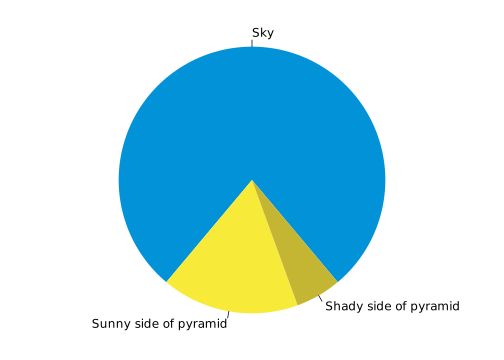
Figure 1: A fancy pie chart.
For posts where we’re using our public data and showing it off, including some
of the code chunks would be great so that readers see how easy it is to use our
data. But for other audiences, it’s probably best to use the echo=FALSE chunk
option so the code is not included in the post.
Including Math
You can embed mathematics by using dollar signs for inline math and double dollars for display math: \(x = \sum_{i=1}^n i\),
\[ \frac{-b \pm \sqrt{b^2 - 4ac}}{2a} \]
Metadata
Each post has a title, author, date, and tags. The draft attribute marks a
post that should not be included in the rendered and published site, such as
this one. Choose bold, active titles, like “Delphi releases new survey data”,
rather than boring titles like “New survey aggregates”.
The author metadata should credit the post author or authors; as shown at the end of this example post, you should also include a block about the authors and linking to their home pages. But in the post text, you should also generously name anyone who helped with parts of your post, e.g., the team members who obtained data or set up a server or developed a package you use.